Finding What No One Had Found: Artificial Creativity and Our Biggest Problems
Creativity is not a human privilege. A machine found in Go what centuries of players had not: that capacity, not the artwork, is the thing to look at.
The Metropolitan Museum of Art
Creativity is generally taken to be a property of the living, and art a property of the human species. The first claim is well supported. The second is a privilege we grant ourselves.
The living creates at scales where you would not expect it. The nematode Caenorhabditis elegans has 302 neurons in the hermaphrodite, mapped one by one since the work of White and colleagues in 1986. It is the only nervous system for which we have the complete wiring, down to the neuron. And that worm does more than absorb food: it alternates between phases of intense local exploration and long directed movements, and it adjusts that switch according to what it has encountered before.
Is that curiosity? The work describing this alternation models it as a foraging strategy that maximises acquired information, which is not the same thing, and specialists are careful not to use the word. But with 302 neurons, the question already arises. If three hundred neurons are enough to raise it, there is nothing surprising about creative behaviour appearing in species that have millions.
What a bird composes
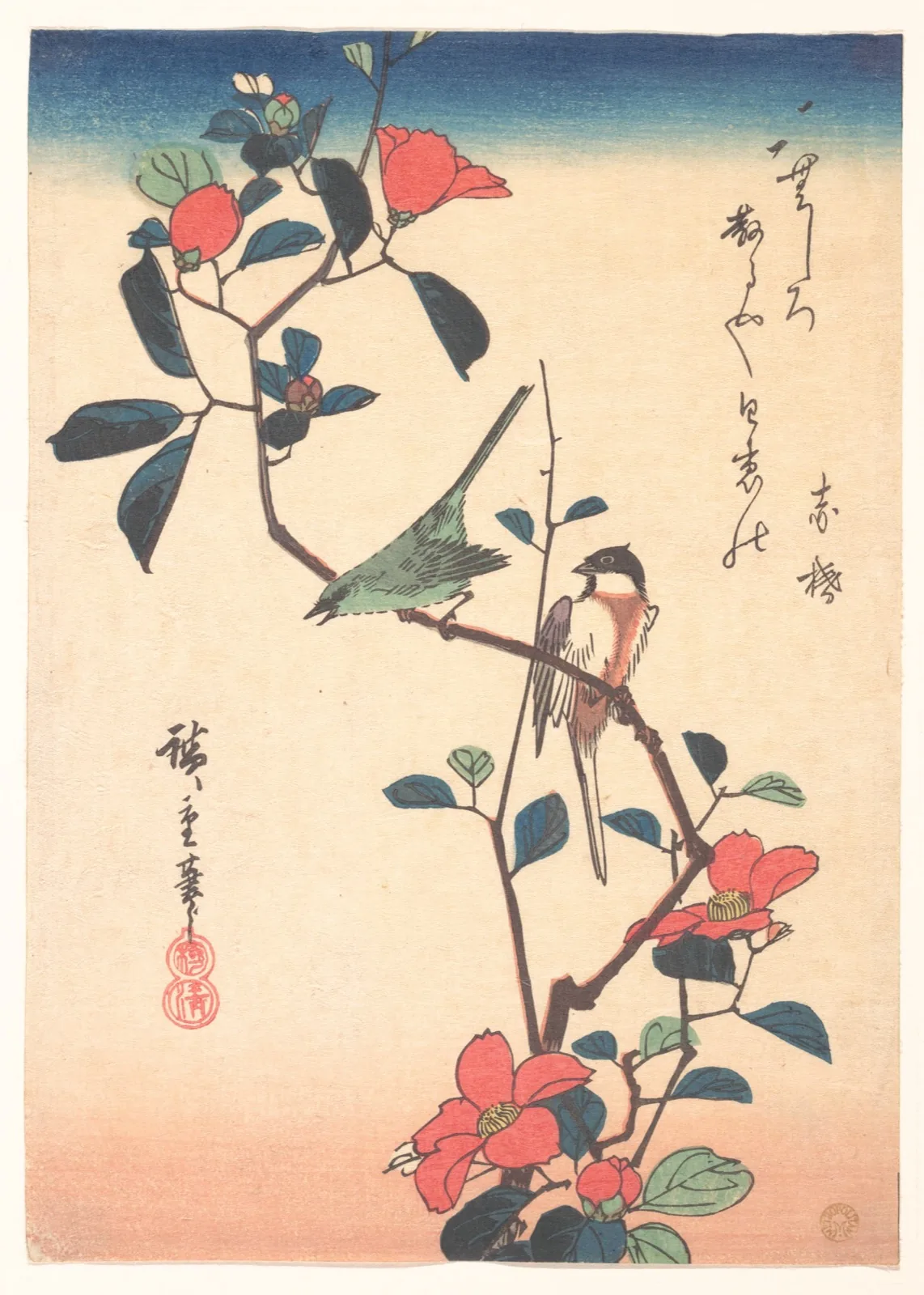
Some bird species build structures made of small sticks resting on a base, decorated with fruit, flowers and butterfly wings. These are not nests: nothing is laid there, nothing is brooded. They are scenes, built to be looked at.
Jared Diamond studied the Vogelkop bowerbird, Amblyornis inornatus, in western New Guinea. Presenting males with poker chips in seven colours, he found that each individual has stable preferences, that those preferences differ between individuals and between populations, and that certain objects go to specific places in the bower. Two valleys a few dozen kilometres apart produce two styles: here a tall tower on a mat of blackened moss with drab decorations; there a low tower topped with a hut, on green moss, with fruit and flowers. Diamond draws a hypothesis from this, carefully phrased: the style might be partly learned, and passed on the way human artistic styles are.
The observation that strikes me most comes from elsewhere, and from another species. Endler and colleagues showed that the great bowerbird arranges its objects along a size gradient that increases with distance, producing, seen from the exact spot where the female stands, an illusion of forced perspective. When the experimenters reverse the gradient, the males restore it within three days.
That is not a reflex. It is a composition, held from a point of view that is not its author’s, and rebuilt when you damage it.
The question a machine asks
In 2017, Ahmed Elgammal, Bingchen Liu, Mohamed Elhoseiny and Marian Mazzone published CAN, Creative Adversarial Networks. The idea sits in a single change to the objective: produce images that stay inside the distribution of what we call art, while departing as far as possible from the styles that were learned. AICAN, the system built on that algorithm by the Art and Artificial Intelligence Laboratory at Rutgers, was trained on roughly eighty thousand images spanning five centuries of Western painting, and it publishes its output online.
Look at one of those images long enough. Depending on the angle, depending on the person, it stirs different sensations, and nothing in the experience warns you of its origin.
The question the team was asking was this: if you teach a machine the foundations of art and style, and push it to generate images that do not follow the established styles, what will it produce?
Mine comes earlier. Where does the real value of a work come from? From the values and emotions the creator meant to convey through it? Or from the emotion the work itself aroused in the person looking at it? If we give more weight to the emotion triggered in the audience, then we have to ask whether human artwork really differs from work that comes out of artificial creativity.
The state at time T
What I have always found most interesting about humans is the gap between experiences of one and the same perceived world.
Two people watching the same film have not lived through the same thing. They build different emotions at each scene, and recall memories of a past that belongs to them alone. If it were possible to open someone’s mind at a given point, the memory stored there would be more unique than a fingerprint.
That chaotic evolution, which everyone goes through across a lifetime, shapes their internal state at every moment. So that when we create something, with or without the intention of communicating information, our creation reflects the state we are in at time T. And that state depends on present conditions as much as it is conditioned by all our past experience.
The Metropolitan Museum of Art
Diverge, then converge
The comparison between an artificial network and a biological brain can be pushed further. I do it carefully, because this is the kind of parallel that costs you.
Several lines of work suggest that we constantly produce divergent thinking: many ideas, good and bad, unsorted. Then we extract the one that stands out because it makes more sense than the others, and that is convergent thinking, attributed to the executive control network. The selection would happen without our really being aware of it. So that moment of creativity, where you begin to imagine something interesting, would go through a generation and then a selection.
That is exactly the shape of the systems producing images today. One part proposes, another validates, and the two strengthen each other until the proposals hold up. The actual process is not the same, and I am not claiming it is. But nothing prevents a network from having its own way of generating content, or that content from turning out to be relevant.
What the sum of humans had not found
Creativity does not stop at art, and this is where the thesis gets serious.
When Einstein began to work out the principle of general relativity, his creativity did not lead him to produce art but mathematical formulas. His richly furnished internal state gave him both a wide diversity of thinkable formulas and the ability to validate a reliable mathematical intuition. Generation, selection: the same shape.
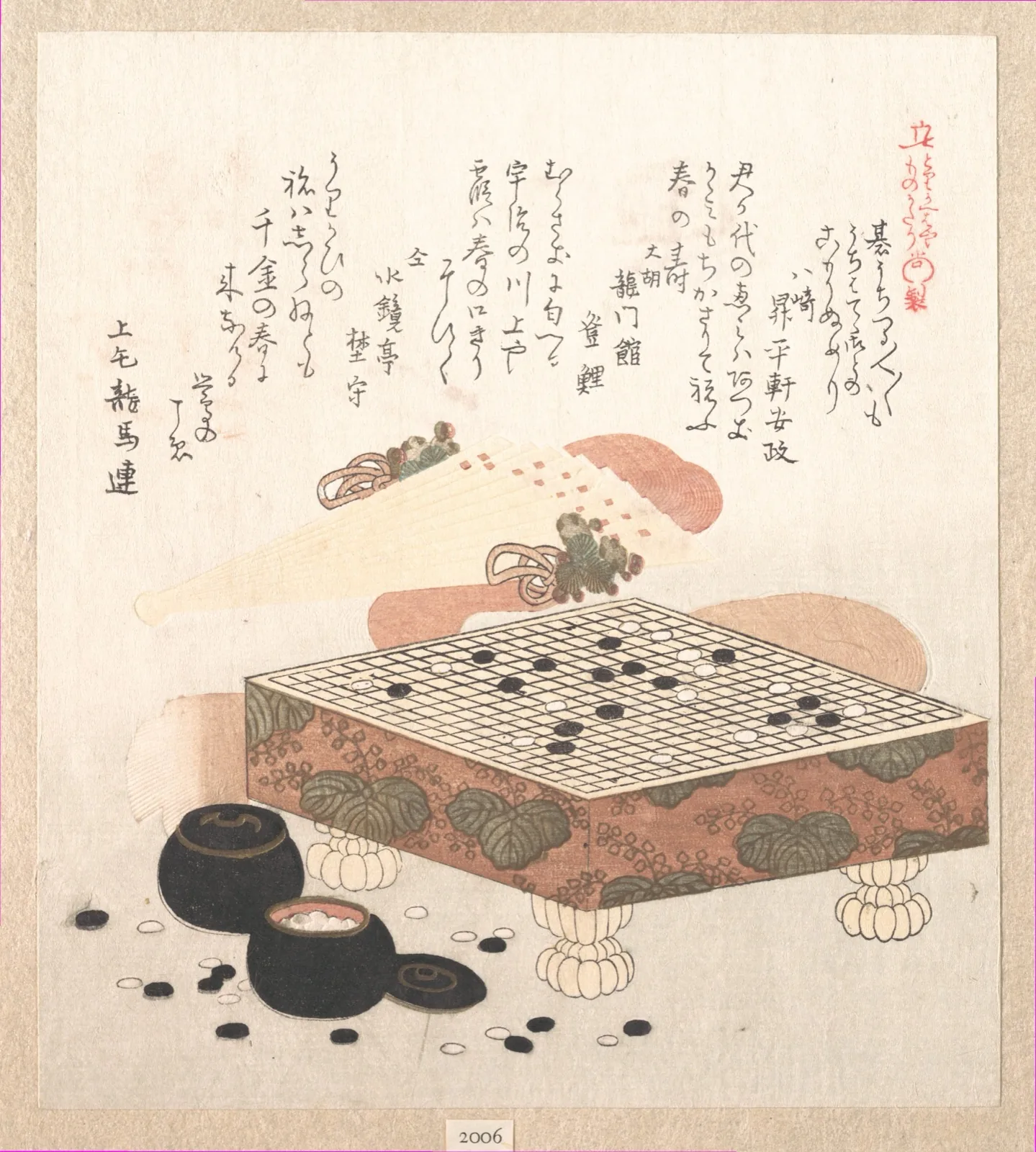
In March 2016, in Seoul, AlphaGo beat Lee Sedol, eighteen times an international title holder, four games to one. What is remembered is not the score, it is move thirty-seven of the second game. A stone placed on the fifth line, judged mistaken by the professional commentators the moment it landed, and which the program’s policy network estimated a human player had roughly a one in ten thousand chance of playing. That figure does not measure the machine’s confidence in its own move. It measures how unlikely the move was for a human.
When the sum of human cognitive abilities gathers around the same point, we are statistically more inclined to find solutions. This is what is called cognitive diversity. Thousands of players, over centuries, and that sum had not been enough to produce that move.
The following year, AlphaGo Zero made the argument sharper still. The system saw no human games at all: it starts from the rules alone and plays against itself. It beats the version that beat Lee Sedol one hundred to nothing, and it rediscovers and then abandons josekis centuries old. You can no longer say it recombines human material, since it never received any.
The Metropolitan Museum of Art
So the question is not so much whether the creativity of a machine can produce art. It is whether it can produce something we would not have found.
And there the answer is already yes. Adding that creativity to the whole of human creative capacity means increasing the number of reachable solutions for the problems we want to solve. Today, because we are only at the beginning, that capacity is known mostly through images, music, poems, or an unheard-of strategy in a game. It is starting to be applied to heavier things: global warming, medical research, the organisation of work at the scale of a society.
That is why, in front of a work produced by a machine, what you should see is not only a work. It is an ability to find, which we are going to need.
Written in January 2019 and republished here without updating. This site is now illustrated only with real public domain works, so the AICAN images the text describes do not appear on this page.